
Table of Contents
Introduction
Email marketing continues to be among the strongest weapons available to small businesses to interact with customers, generate sales, and strengthen brand loyalty. Of all the dozens of different tools being used today, Constant Contact is still one of the most recognized brand names in the industry. Its intuitive design and solid features have helped the successful implementation of email campaigns by millions of small businesses for decades.
In 2025, Constant Contact is still rivaling industry giants like Mailchimp, HubSpot, and ActiveCampaign. But the big question most business owners need to know is: Is Constant Contact still worth using in 2025? In this review, we will review its features, pricing, pros and cons, and how it compares with other alternatives so you can decide if and why it’s the best email marketing solution for your business.
Key Features of Constant Contact
As far as email marketing is concerned, Constant Contact is known for offering a combination of simplicity and robust features, which have endeared it to small businesses in 2025. Some of its most appealing features include:
Easy Email Templates
Constant Contact has more than hundreds of professionally designed email templates. Its drag-and-drop editor makes it easy to customize layout, color, and brand without design or coding experience.
Marketing Automation
Automation is biggest advantage. From welcome emails for new subscribers to cart abandonment reminders, it helps businesses save time along with engaging customers more effectively.
List Management and Segmentation
Manage contacts with ease in this company. You can segment lists based on behavior, demographics, or engagement so that the right people are being targeted in your campaigns.
Analytics and Reporting
Constant Contact also has live reporting features that track open rates, click rates, and conversions. This allows businesses to analyze campaign effectiveness and adjust accordingly.
Compatibility with Well-Known Tools
Constant Contact is integrated natively with e-commerce websites like Shopify, WooCommerce, and BigCommerce, as well as CRM software and social media platforms. This renders the tool applicable to a range of business requirements.
In general, this company offers everything a small business requires to deliver professional email campaigns in an easy-to-use and reliable fashion.
Constant Contact Pricing Plans in 2025
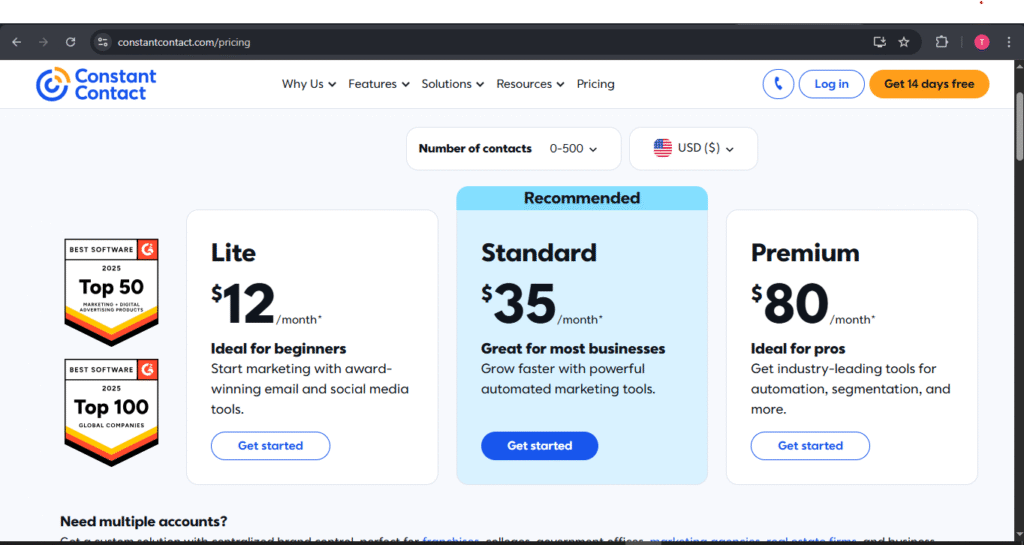
When evaluating any email marketing tool, pricing is one of the first things small businesses consider. Constant Contact offers flexible pricing in 2025, designed to meet the needs of startups, growing businesses, and larger organizations. Its plans are based on the number of subscribers, with additional features unlocked at higher tiers.
Below is a breakdown of the Constant Contact pricing plans in 2025:
| Plan | Monthly Price (Starting) | Best For | Key Features |
|---|---|---|---|
| Lite | $12/month | Beginners & small lists | Basic email marketing, limited templates, 1 user |
| Standard | $35/month | Growing small businesses | Advanced email automation, A/B testing, analytics, up to 3 users |
| Premium | $80/month | Larger businesses & e-commerce | Advanced segmentation, customer journey mapping, unlimited users, priority support |
Pros and Cons of Constant Contact
When evaluating this company, it’s important to understand both its strengths and weaknesses to determine if it’s the right email marketing tool for your business in 2025.
Pros
- User-Friendly Interface – Constant Contact offers an intuitive drag-and-drop editor, making it easy for beginners to design professional-looking emails without coding skills.
- Powerful Automation – With automated welcome emails, follow-ups, and drip campaigns, Constant Contact helps small businesses save time while maintaining engagement.
- Comprehensive Analytics – Track open rates, click-through rates, and campaign performance in real-time, allowing businesses to make data-driven decisions.
- Wide Range of Integrations – Connect Constant Contact with popular tools like Shopify, WordPress, and CRMs to streamline marketing workflows.
- Strong Support – Offers live chat, phone support, and a large knowledge base to assist users whenever needed.
Cons
- Pricing Can Be High at Scale – For businesses with large email lists, Constant Contact’s cost can become expensive compared to alternatives.
- Limited Advanced Features – While great for beginners, some advanced marketers may find segmentation and automation options less robust than competitors like ActiveCampaign.
- Template Limitations – Although the templates are easy to use, they can feel somewhat limited in design flexibility for highly customized campaigns.
In summary, This company remains a reliable and beginner-friendly email marketing tool for small businesses. While it may not have every advanced feature, its ease of use, automation, and analytics make it a strong contender for businesses that prioritize simplicity and efficiency in 2025.
Constant Contact vs Other Email Marketing Tools
When choosing the right email marketing platform for your business, it’s essential to see how Constant Contact stacks up against competitors like Mailchimp, HubSpot, and ActiveCampaign. Each tool has its strengths and weaknesses, and understanding these differences helps you make an informed decision.
| Feature / Tool | Constant Contact | Mailchimp | HubSpot | ActiveCampaign |
|---|---|---|---|---|
| Ease of Use | Beginner-friendly, intuitive interface | Beginner-friendly, slightly more complex | User-friendly, but feature-heavy | Moderate learning curve |
| Automation | Basic to advanced automation | Advanced automation options | Advanced automation with CRM integration | Highly advanced automation |
| Email Templates | 100+ responsive templates | 100+ templates | 50+ templates, customizable | 50+ templates |
| Reporting & Analytics | Real-time reporting, simple dashboards | Advanced analytics & A/B testing | Advanced reporting & CRM tracking | Detailed reports, predictive insights |
| Integrations | E-commerce, CRM, social media | Many apps and integrations | Extensive CRM & apps | Wide integrations with apps |
| Pricing | Starts at $10/month | Free & tiered pricing | Free & premium plans | Paid plans only |
| Ideal For | Small businesses, nonprofits | Small to medium businesses | Growing businesses & enterprises | Businesses needing advanced automation |
Analysis
- Ease of Use: this company is known for its simple, intuitive interface, making it ideal for beginners or small business owners who want a straightforward solution.
- Automation: While Mailchimp and ActiveCampaign offer more advanced automation workflows, Constant Contact provides sufficient tools for most small business campaigns.
- Pricing: Constant Contact’s pricing is transparent and competitive for small businesses, unlike ActiveCampaign which can become expensive as contacts grow.
- Best Fit: If you’re a small business or nonprofit looking for an easy-to-use, reliable platform, Constant Contact remains a strong contender. However, if you need highly advanced automation and CRM features, HubSpot or ActiveCampaign may be better suited.
Overall, Constant Contact holds its own in 2025 by providing a balanced mix of ease-of-use, automation, and affordability, especially for small businesses and beginners.
Conclusion
Having tested its usability, cost, and functionality, Constant Contact is still a reliable choice for small businesses in 2025. Its simplicity, powerful automation, ample email templates, and seamless integrations make it perfect for beginners as well as businesses aiming to grow their email marketing without an extensive learning process.
But if your business requires sophisticated segmentation, more powerful analytics, or enterprise-scale automation, other products like HubSpot or ActiveCampaign may be superior in capability. For most small businesses, nonprofits, and online sellers, Constant Contact has excellent value, combining ease of use with essential marketing capabilities.
In short, Constant Contact is still a strong player in the email marketing scene, and it’s still well worth considering for companies that appreciate simplicity, effectiveness, and dependability in 2025.